

اخبار العرب-كندا 24: السبت 10 يناير 2026 02:32 مساءً
We may all have lost some sleep in the wake of the U.S. President’s unfiltered, dangerously disheartening intention to take over the self-governing Danish territory of Greenland, apparently by force if necessary.
But let’s use this scary new normal in Canada-United States relations, fuelled by Trump’s oft-repeated intentions to also annex Canada, as a “teachable moment” – one that might help us determine where we stand militarily, rather than rhetorically, in our current state of defence preparedness.
And what better approach to take now than to compare Canada with small, social democratic Denmark by way of military preparedness in the not-so-impossible-anymore scenario of a U.S military invasion. If forced to stand alone, before the inevitable happens, which of the two countries has the superior weapon and technology capability to put up a stronger initial fight against the American behemoth?
Advertisement
Advertisement
Advertisement
Advertisement
Sadly, for us, based on key indicators of conventional military preparedness, the answer appears to be Denmark. Despite its small size and population (six million, as opposed to Canada’s 41 million), and generous social benefits, Denmark has more modern and technologically advanced ships, aircraft, tanks and air defence systems.
Equally important is the impressive pace at which Denmark’s social-democratic-led government is bringing new weapon systems into service. A pace that would surely make our Generals and Admirals, not to mention the most conservative pro-military Canadian politician here, go green with martial envy.
RECOMMENDED VIDEO
Let’s start with the senior service since any intrusion into the Danish territories of Greenland or the Faroe Islands, or, by extension, the Canadian Arctic, would obviously involve the navy.
Canada has the longest coastline in the world at 243,797 km. Denmark and Greenland have a combined coastline of approximately 52,837 km. And while Canada might dare boast to have more warships than Denmark, let’s look at how they compare in terms of age and capability and adaptability.
Advertisement
Advertisement
Advertisement
Advertisement
The mainstay of the Royal Canadian Navy is our aging fleet of 12 Halifax-class frigates constructed in the early to mid-1990s. Their planned replacement by 2040 (that’s not a typo) will likely coincide with the plethora of history books that no doubt will be written about the Trump regime and the wars he started.
The oldest warships on the Danish side, their four Thetis-class frigates, are about the same age as our sole Canadian frigate fleet. Recognizing their impending obsolescence, the Danish government has contracted for their replacement by the Danish-built MPV-80, the design of which has been modified to operate in Arctic environments. This replacement for the grandmother of the Danish war fleet is scheduled to be completed in 2029, eleven years before Canada’s planned sole-warship replacement.
Among the newer Danish warships in service are their 3 Iver Huitfeldt Air Defence Frigates, which were completed in 2012. Among the ship’s multiple armaments are the new Norwegian-built Naval Strike Missiles. Denmark also has in service two Absalon-class frigates, completed in 2005, which feature an impressive suite of anti-ship and surface-to-air missiles and torpedoes. Absalon-class ships are also designed to double as transport and a base of operations for a landing force.
Most impressive from an operational planning perspective is that the Danish ships have advanced modular design that allows for exchangeable platforms. Thus, depending on the impending threat, Danish ships can be efficiently re-purposed and re-armed with different weapon platforms and systems.
Advertisement
Advertisement
Advertisement
Advertisement
No ships of this nature operate within the Royal Canadian Navy.
RECOMMENDED VIDEO
In addition to its smaller coastal patrol vessels, the Royal Danish Navy has operated, since 2008, three offshore patrol vessels – the Knud Rasmussen Class, comparable in purpose to our recently acquired Harry DeWolf offshore patrol vessels, of which we now have five of six built.
However, unlike our Canadian ships, the Danish patrol vessels carry multiple weapon systems, including a 76 mm gun, RIM-162 missiles and MU-90 anti-submarine warfare torpedoes.
Canada’s Harry DeWolf patrol vessels, in their current form, are only equipped with one Mark 38 25mm machine gun as their primary weapon. Which makes sense, since, as I have reported here before, our new naval ships are “all sight and no fight” and were never designed, according to the Navy, to engage in actual combat when they were built.
Advertisement
Advertisement
Advertisement
Advertisement
As far as air power is concerned, the Royal Canadian Air Force, which protects the second-largest airspace in the world, continues to fly an outdated fleet of approximately 85 1980s-era F-18s. And replacements seem a long way off as our government continues to dither and delay as to which new fighter aircraft to buy.
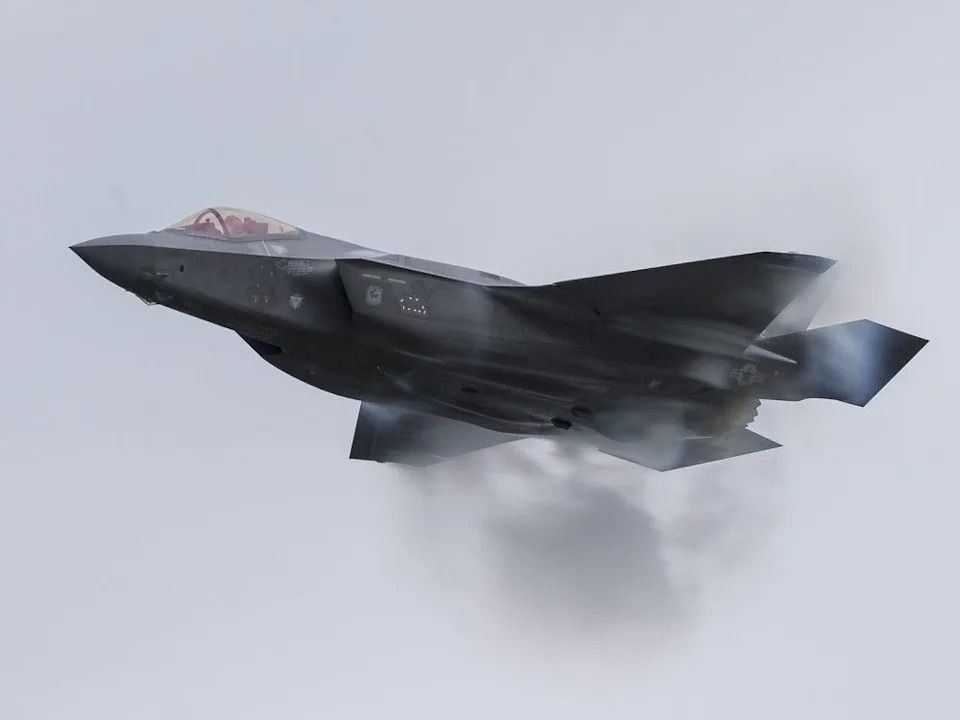
Denmark, on the other hand, has already taken delivery of 21 of 43 F-35s, with delivery of the remaining aircraft expected to be completed by 2027. Granted, Denmark’s new F-35s, as with Canada’s decades-old F-18s, would likely be blocked from maintenance components and software updates by a hostile U.S. in the event of a war. However, fighter-to-fighter the more advanced Danish planes should, technologically, survive longer in an air battle against their American equals before eventually running out of replacement parts.
Canada’s debate continues over whether to buy more F-35s (pictured) or the Swedish Gripen.
But even more indicative of Danish military resolve compared to Canada’s is the pace at which their procurement program is addressing past shortcomings. Once sharing a basement status with Canada when it came to ground-based air defence, Denmark is now splurging in its acquisition of missile defence systems. These include the Ukraine-war proven NASAMS 3 medium range surface-to-air missiles with one of three units already in operation.
By 2027, Denmark is also expected to receive the first of two EUROSAM SAMP/TNG long-range air defence systems. Other medium-range air defence systems that the Danes are expeditiously procuring into their arsenal include the MBDA VL MICA and IRIS-T SLM medium-range surface-to-air missile systems – both of which should be fully operational by 2027.
Advertisement
Advertisement
Advertisement
Advertisement
On the army side, the Danes have also acquired eight Israeli PULS multiple rocket launchers to provide indirect artillery support for its ground forces.
Missile-wise the Canadian Army, to date, stands on guard for thee with a few newly acquired RBS-70 man-portable short-range systems. These are mainly being used to protect our contingent in Latvia against hostile drones and helicopters. At least our army is no longer missile-less as I reported here in 2023!
There are also the usual promises of more ground-based air defence systems becoming operational, fingers crossed, sometime around 2030.
So, let’s all try and continue be patient, eh?
RECOMMENDED VIDEO
Battle tanks are also an area where tiny Denmark has quickly upgraded its arsenal. In 2023, the Danish Army completed its acquisition of 44 upgraded Leopard 2A7DK tanks, which are a more advanced version of the 54 Leopard 2A4 and 20 Leopard 2A6 tanks that Canada, the second largest land mass in the world, currently has.
Advertisement
Advertisement
Advertisement
Advertisement
Even more asymmetric are the two nations’ actual boots on the ground sovereignty protection capability in the Arctic. As I have reported here and in other media outlets, Canada continues to rely almost exclusively on the Canadian Rangers to maintain a continuous military presence in the Arctic. These Rangers are a non-combat auxiliary sub-component of the Armed Forces Reserves and, if trained, receive about a week of military training.
Contrast this with the Danish Sirius Sledge Patrol. Comprised of specially selected regular military personnel from the Danish Forces, the Sirius patrol is tasked with conducting continuous sovereignty patrols over Greenland on a sustained basis. Their members are subject to a rigorous training program covering topics such as demolition, reconnaissance, radio communications, advanced first aid, ice/water survival, sled dog handling and generator repair, to name a few.
Nothing remotely akin to Sirius Patrol exists in the Canadian Armed Forces. And looking at their respective capabilities in sovereignty protection, I would gladly take 50 trained Danish Sirius Patrol professional personnel over 5000 negligently trained Canadian Ranger citizen militia if forced to survive against, recce, or evade an invading force in the Arctic.
Advertisement
Advertisement
Advertisement
Advertisement
Let’s also not forget that Denmark has military conscription. Though Danish military conscription is currently based on a lottery system and does not necessarily require all to serve, the country is nonetheless making changes to ensure it has enough trained personnel on hand if volunteer enlistment falls short.
Recently, and quite appropriately for today, Danish women became subject to military conscription. Additionally, the compulsory military service term in Denmark has been extended to 11 months. Denmark has also, in recent months, ramped up its call-up of its reserves consisting of recently trained conscripts.
Please pick me up off the floor if Canada succeeds in implementing the same conscription-lite system here before we are officially at war and facing imminent invasion.
We have all heard the expression, applied in different contexts, that “the truth will set you free.” We certainly once punched beyond our weight in the two World Wars. Unhelpful today is Canada’s increasingly dangerous defence delusion of NATO military equality and respectability – a delusion that continues to permeate through multiple layers of rationalization and self-exculpatory filters.
Advertisement
Advertisement
Advertisement
Advertisement
The result is that we are left with the impression, in spite of the evidence to the contrary, that somewhere close at hand we have our own big, beautiful fighting military machine – one that is waiting to emerge like a phoenix and roll out and fight on a moment’s notice should war come.
Let’s rather reflect on how we stand, unfiltered, with much smaller NATO allies like Denmark, the Netherlands, Norway and Sweden – allies that Canada should at least stand with as a military equal, but sadly, falls short.
– Smol is a retired military intelligence officer who served in the Canadian Armed Forces for more than 20 years. He is currently completing a PhD in military history. Reach him at rmsmol@gmail.com
تم ادراج الخبر والعهده على المصدر، الرجاء الكتابة الينا لاي توضبح - برجاء اخبارنا بريديا عن خروقات لحقوق النشر للغير


