


اخبار العرب-كندا 24: الخميس 25 ديسمبر 2025 12:56 مساءً
Gathie Falk, the acclaimed painter, sculptor and installation artist, has died. Falk died in Vancouver on Dec. 22 at the age of 97.
“Gathie was fearless,” said Andy Sylvester, owner of the Equinox Gallery and a longtime friend. “She remained a very driven artist, curious about the world in front of her, and able to adapt the materials required to make the objects that her ideas spawned.”
Falk worked in many different mediums, including sculpture, papier-mâché, painting, installation and performance art. Sylvester called her work “a veneration of the ordinary and the everyday.”
Advertisement
Advertisement
Advertisement
Advertisement
One of her best-known works, Cement With Poppies, 1982, was a painting of the poppies that spilled out over the sidewalks that encircled her home in Kitsilano.
“I feel that unless you know your own sidewalk really intimately, you’re never going to be able to look at the pyramids and find out what they’re about,” she once said.
Her work was also extraordinary, provoking passionate and immediate responses. Sylvester recalls showing one of Falk’s early works, Herd I and Herd II 1974-1975, an installation of painted plywood horses galloping, caught at that perfect moment where all four hooves are off the ground.
“Luke Rombout, then director of the Vancouver Art Gallery, came into the gallery, saw it, jumped on the desk and said the VAG would like to buy it. She was delighted,” said Sylvester.
Advertisement
Advertisement
Advertisement
Advertisement
Born Jan. 31, 1928, in Alexander, Manitoba, to Russian Mennonite parents, Falk grew up in poverty after her father died when she was just 10 months old. During her youth, Falk said she knew she would become an artist, even though she had no crayons or materials at home.
When she went to school and had access to pencils and paper, she became “obsessed with drawing.”
At the age of 16, she was forced to discontinue her education in order to contribute financially, picking fruit and waiting tables. After the family moved to Vancouver when Falk was 18, she found work in a luggage factory, where her job was sewing pockets into the inside of suitcases.
She later said that handiwork contributed to her ability and skill in creating works in different materials.
Advertisement
Advertisement
Advertisement
Advertisement
In 1952, Falk became a schoolteacher, a job she “hated,” but stuck with in order to help support her mother and pay off the family’s debt. During that time, she took evening and summer classes in art and design.
“At the age of 37, she decided to cash in her modest pension and become a full-time artist. She said the only way to do it was to go all in,” said Sylvester.
From the beginning, Falk was experimental, doing work that was connected to the pop-art movements of the 1960s. “She did performance art at shows in galleries at a time when that was barely known here in Vancouver,” said Sylvester.
An early mixed-media installation titled Home Environment was, “arguably, the work that established her reputation as a serious artist working with a visual language and concepts that were on par with some of the most avant-garde artists of the day,” according to the Art Institute of Canada.
Advertisement
Advertisement
Advertisement
Advertisement
While her work was “extraordinarily sophisticated,” said Sylverster, it was also grounded in everyday life. One of her most well-known works, 196 Apples, part of her 1969-1970 Fruit Piles series, was inspired by the perfect stacks of fruit that she saw at the local greengrocers in her neighbourhood.
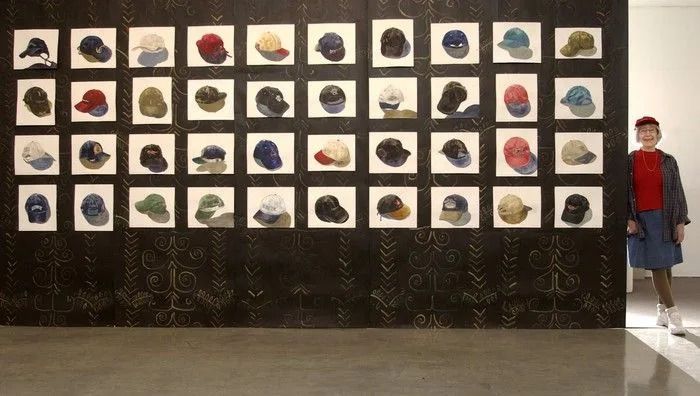
Gathie Falk at her show at Equinox Gallery in 2004.
Sylvester said discipline brought structure and productivity to her life.
“She was asked about creativity in an interview once, and the interviewer said it must be so lovely to be inspired to go into your studio every day. She replied, ‘I don’t think I am inspired every day. I have to function like an athlete. When you aren’t inspired, you just get to work. You stretch canvases, you make molds, you clean the studio. Part of your practice is that you prepare every day.”
Falk had over 50 solo shows and three retrospectives during her lifetime, the Gathie Falk Retrospective in 1985 at the Vancouver Art Gallery, Gathie Falk 2000 at the Vancouver Art Gallery, curated by Bruce Granville, and Revelations at the McMichael Gallery in 2023, which travelled across the country.
Advertisement
Advertisement
Advertisement
Advertisement
Falk was the recipient of the Governor General’s Award in Visual and Media Arts (2003), the Audain Prize for Lifetime Achievement in the Visual Arts (2013), the Gershon Iskowitz Prize (1990), and both the Order of British Columbia (2002) and the Order of Canada (1997).
Age did not slow Falk’s creative output, but it did change the mediums in which she worked. “She began to make extraordinarily sophisticated pieces in pâpier-maché, which was lighter and easier to move around,” said Sylvester, who recalls hoisting a canoe with Falk, and carrying it out of her studio and down the street to the Equinox gallery, “much to the delight of her neighbours.”
“She was very much her own person, and if there was something she wanted to do, she would just do it,” said Sylvester. “She was a truly revolutionary artist.”
dryan@postmedia.com
Related
تم ادراج الخبر والعهده على المصدر، الرجاء الكتابة الينا لاي توضبح - برجاء اخبارنا بريديا عن خروقات لحقوق النشر للغير


