


اخبار العرب-كندا 24: الثلاثاء 30 ديسمبر 2025 12:32 مساءً
A new land-use plan that Alberta’s government has for the province’s Upper Smoky region is drawing criticism from environmentalists who say they believe it lacks sufficient environmental safeguards, which poses a significant threat to the endangered southern woodland caribou.
Effective Jan. 1, 2026, the Upper Smoky Sub-Regional Plan will guide industrial activity on the 13,000-square-kilometre area between Grande Prairie and Grande Cache. The plan attempts to carry out two mandates: protect and recover critical caribou habitat to federal standards, and support the province's goal to double oil and gas production.
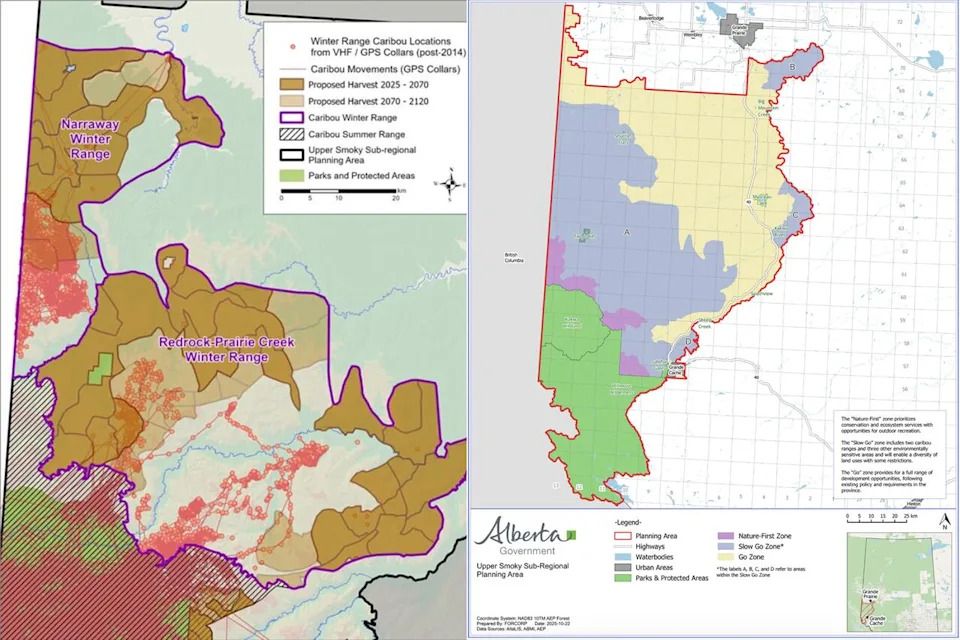
Tara Russell, a program director with the Canadian Parks and Wilderness Society (CPAWS), has provided recommendations for the plan to advocate for caribou habitat protection since 2019. She said she worries that under the new framework, the sub-region’s critical habitat for the Narraway and Redrock-Prairie Creek wildland caribou herds will be left with less than half of their original habitat over the next century.
Advertisement
Advertisement
Advertisement
Advertisement
“It's quite catastrophic and I don't think either of these populations will survive that amount of habitat loss,” she said.
(Canadian Parks and Wilderness Society Northern Alberta (left) and the Alberta government (right))
Caribou populations in Alberta have been in steep decline for decades due to habitat loss and predation.
The sub-regional plan is intended to support an agreement signed in 2020 between Alberta and Ottawa to safeguard caribou habitats, and to try to avoid the potential for legal action being taken by the federal government under the Species at Risk Act, which the woodland caribou have been listed on since 2002. That agreement ended in October.
In 2024, a provincial report showed that little progress had been made towards federal benchmarks, and several environmental groups argue the Upper Smoky Sub-Regional Plan does not reverse this trend.
3 zones with different regulations
The plan divides the region into three zones with varying degrees of industry restrictions.
Advertisement
Advertisement
Advertisement
Advertisement
The “nature first” zone is directly north of Willmore Wilderness Park and Kakwa Wildland Provincial Park in the southern end of the subregion. The new protected areas bar new industrial projects, but honour existing contracts for resource extraction. This high-elevation, mountainous terrain is used by caribou during the summer months.
The “slow-go" zone encompasses two caribou ranges and three other sensitive areas in the central-western and eastern parts of the subregion. Industry is still fully permitted in this zone. The “slow” part refers to access management restrictions like sharing roads and restoration requirements, but does not ban logging or drilling. The lower elevation forested foothills are where caribou rely on shelter and foraging in the winter.
The “go" zone promises business as usual and encompasses the majority of the eastern foothills. It includes the area that is not considered caribou habitat.
The new zones do not alter current coal policies, including in the designated protected areas.
Logging strategies and wildfire mitigation
The final plan also shifts forestry operations. As stated in the plan, current approved forestry practices create dispersed harvesting areas, which involves disturbing smaller land plots, and require more roads to be built. This approach fragments the land as more plots are disturbed, but in smaller sections.
Advertisement
Advertisement
Advertisement
Advertisement
The new approach requires logging companies to adopt an aggregate harvesting approach which will see that larger areas are logged on each harvest, but will reduce the fragmentation of the landscape, reduce the number of temporary roads and decrease construction and maintenance costs for logging companies.
All logging that will be permitted under the banner of wildfire mitigation is excluded from the plan. That aspect will be developed by Alberta's Ministry of Forestry and Parks within 60 days of the plan coming into effect.
“Wildfire mitigation planning will consider environmental impacts in alignment with the need to reduce the risk of large-scale fires in the area,” Ryan Fournier, a spokesperson for Alberta's Ministry of Environment and Protected Areas, wrote in an email to CBC News.
Russell said she believes wildfire mitigation is a “thinly veiled excuse” to further log caribou habitat without public consultation.
Advertisement
Advertisement
Advertisement
Advertisement
CPAWS Northern Alberta did an analysis of the timber harvesting enabled by the plan, which it says shows that both undisturbed and old forest critical habitat will not recover enough to support caribou recovery for over 100 years.
“Those estimates that we made don't include whatever happens through the fire mitigation,” Russell said. “So this is the best-case scenario under this plan.”
Varied progress, varied support
In his email, Fournier said the United Conservative government is protecting caribou more than any provincial government in history.
“Through common-sense conservation, we’ve recovered over 4,500 kilometres of caribou habitat in the past five years (compared to just 87 under the NDP’s entire time in government) and announced $55 million in new funding just this spring,” his statement reads in part.
Advertisement
Advertisement
Advertisement
Advertisement
Russell said she does not contest that, but pointed out that over 250,000 kilometres of seismic lines remain. The exploration tool used by oil and gas companies creates grids of deforestation to measure seismic activity to determine if there are oil or natural gas resources in the area.
The criss-cross patterns act as highways for wolves, which make it easier for them to prey on caribou.
Pamela Narváez-Torres, a conservation specialist with the Alberta Wilderness Association, issued a joint statement alongside other environmental groups to criticize the land-use plan's priorities.
“The plan outlines an intention to initiate forest regrowth on old seismic lines, which is a costly and meaningless activity for caribou if their critical habitat continues to be removed, particularly through timber cutting," she said. "Why restore seismic lines if there is no habitat to allow caribou to exist?”
Advertisement
Advertisement
Advertisement
Advertisement
Despite environmentalists pointing out their concerns with the plan, Ryan Ratzlaff, reeve for the Municipal District of Greenview, said he believes the plan represents a good balance between economic growth and caribou protection.
“I think we'll preserve that habitat for many years to come, and it will just get into this cycle where it just slowly gets managed over time and harvested and keeps habitat, but also keeps our wildfire risk low because we are managing the forest," he said.
Keean Nembhard, a spokesperson for Canada's Ministry of the Environment, Climate Change, and Nature, provided CBC News with statement that said the federal government is committed to the protection of species at risk through collaboration with provinces and territories.
"Over the last five years, the department has remained engaged with the province of Alberta to communicate feedback on progress towards the commitments in the agreement, including sub-regional plans," his statement reads in part.
“The province manages land use and caribou populations in Alberta, and is best placed to describe how the sub-regional plan will protect caribou herds.”
تم ادراج الخبر والعهده على المصدر، الرجاء الكتابة الينا لاي توضبح - برجاء اخبارنا بريديا عن خروقات لحقوق النشر للغير


