

اخبار العرب-كندا 24: الخميس 18 ديسمبر 2025 07:32 صباحاً
A 28-year-old man, paralysed by a high-level spinal cord injury for eight years, has successfully controlled devices using only his mind just five days after undergoing implant surgery in China.
The breakthrough forms part of the country’s first clinical trial of a fully implanted, fully wireless, fully functional brain-computer interface (BCI).
BCIs connect a person's nervous system to devices capable of interpreting their brain activity, allowing them to act - such as using a computer or moving a prosthetic hand - by the sheer force of their thought.
Advertisement
Advertisement
Advertisement
Advertisement
“He can control household appliances and even operate his wheelchair - all of this can be achieved,” said Professor Mao Ying, the president of Huashan Hospital at Fudan University.
The device, developed by Shanghai NeuroXess, uses 64 electrodes - each just 1 per cent the width of a human hair - making it one of the smallest and least invasive implantable BCIs in the world.
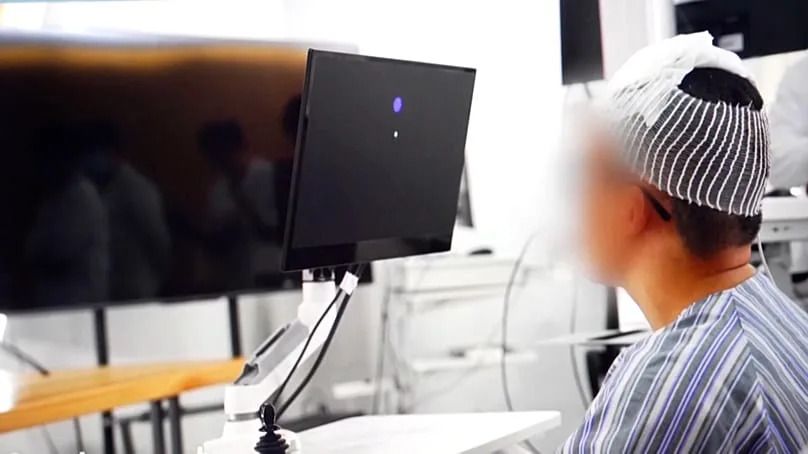
A paralysed man tests a brain-computer interface device - Credit: AP Photo
The electrodes are implanted in the brain, while the controller, battery, antenna, and processor sit beneath the skin in front of the chest.
Advertisement
Advertisement
Advertisement
Advertisement
An external wireless charging dock, in a similar style to what you'd see with a phone charger, allows the device to be charged and used independently.
“The built-in battery is a very important step. Achieving sustained power supply and long-term usability is a key consideration for applying this technology to the human body,” said Zhang Xu, a neuroscientist and academician of the Chinese Academy of Sciences.
A month and a half after the surgery, the patient can control smart home devices, browse the internet, play video games, and operate a wheelchair.
Other BCI clinical trials
The experts said devices like this could transform the lives of millions worldwide living with paralysis. Elon Musk's Neuralink implant is probably the best known.
Advertisement
Advertisement
Advertisement
Advertisement
In a video posted on X, Neuralink patient Rocky Stoutenburgh – who was paralysed in 2006 – demonstrated his ability to move a robotic arm using his mind, bringing the limb to his face and kissing it.
“Participants in our clinical trials have extended digital computer control to physical devices such as assistive robotic arms,” Neuralink said on X, which is also owned by Musk.
“Over time, we plan to expand the range of devices controllable via Neuralink.”
Musk said more than 10,000 people have signed up for Neuralink’s patient registry, hoping to participate in trials for the device.
تم ادراج الخبر والعهده على المصدر، الرجاء الكتابة الينا لاي توضبح - برجاء اخبارنا بريديا عن خروقات لحقوق النشر للغير


