



اخبار العرب-كندا 24: الجمعة 9 يناير 2026 01:56 صباحاً
Two stunning new images of the interstellar comet 3I/ATLAS - one captured from Earth by the Gemini North telescope in Hawaii, and another taken from deep space by NASA’s Europa Clipper spacecraft - have been released to the world.
The comet made global headlines in 2025 when astronomers confirmed it was passing through our Solar System after forming around a distant star.
It is thought to be the oldest comet ever observed - and one of only three interstellar objects ever discovered in our Solar System.
Advertisement
Advertisement
Advertisement
Advertisement
The first image was taken on November 26, 2025 using the Gemini Multi-Object Spectrograph on the Gemini North telescope, which sits atop Maunakea - a dormant volcano on the Pacific island of Hawaii.
Image of comet 3I/ATLAS captured by the Gemini North telescope, 26 November 2025. - Credit: International Gemini Observatory/NSF NOIRLab
Because comets move quickly across the sky compared with background stars, the telescope had to track the comet’s motion during long exposures. This causes stars in the background to appear as streaks. The final image has since been processed to correct for this effect, keeping the stars fixed in place.
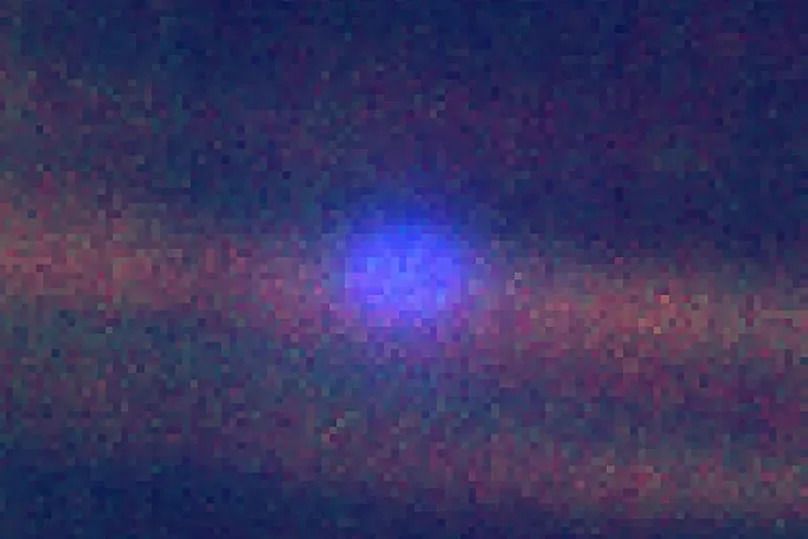
NASA has also released an image of 3I/ATLAS captured by the Europa Clipper spacecraft, which launched in October 2024 and is currently travelling to Jupiter.
Europa Clipper’s primary mission is to study Europa, one of Jupiter’s largest moons.
Interstellar comet 3I/ATLAS captured by NASA's Europa Clipper spacecraft, 6 November 2025. - Credit: NASA/JPL-Caltech/SWRI
Although the spacecraft will not reach the Jupiter system until 2030, its instruments are already active, allowing it to observe and capture passing objects.
Advertisement
Advertisement
Advertisement
Advertisement
NASA scientists used this opportunity to turn Europa Clipper’s camera towards 3I/ATLAS, capturing this unique view of the comet from space as it passed through the inner Solar System.
Combining multiple wavelengths of UV light, the image shows the coma of gas (blue and green) and dust (red) that surrounds the comet’s nucleus.
Europa Clipper observed 3I/ATLAS on for a period of about seven hours, from a distance of around 164 million kilometres.
A rare visitor from beyond our Solar System
Comet 3I/ATLAS was discovered on July 1, 2025 and quickly became one of the biggest space science stories of the year.
Unlike most comets, which form within our own Solar System, 3I/ATLAS originated far beyond it.
Advertisement
Advertisement
Advertisement
Advertisement
As only the third confirmed interstellar object ever recorded - after ʻOumuamua in 2017 and 2I/Borisov in 2019 - 3I/ATLAS sparked attention for its icy core enveloped by a coma, the luminous halo of gas and dust.
Since its discovery, scientists have been racing to observe the comet using some of humanity’s most powerful telescopes, before it exits the Solar System and disappears from view forever.
The comet also sparked speculation about a potentially more mysterious origin. Observations from the Atacama Large Millimeter Array (ALMA) showed it veered slightly -four arcseconds off its predicted path - and its colour shifted dramatically, from reddish to deep blue.
Advertisement
Advertisement
Advertisement
Advertisement
In a blog post, Harvard astrophysicist Avi Loeb suggested the anomaly might even indicate "the technological signature of an internal engine," though most scientists cautioned that natural explanations were far more likely.
As of now, no concrete evidence has supported the theory that 3I/ATLAS was sent by aliens. On the contrary, recent efforts to find markers of extraterrestrial technology on 3I/ATLAS came up empty.
On December 18, a day before 3I/ATLAS reached its closest point to earth, astronomers used the Green Bank Telescope in West Virginia to search the comet for "technosignatures," or measurable signs of alien technology. But the world's largest fully steerable radio telescope could not find anything of note.
For now, 3I/ATLAS continues its brief, spectacular journey through our cosmic neighbourhood. According to NASA, its final significant encounter will be its close flyby of Jupiter in March 2026, before leaving our solar system for good.
تم ادراج الخبر والعهده على المصدر، الرجاء الكتابة الينا لاي توضبح - برجاء اخبارنا بريديا عن خروقات لحقوق النشر للغير


