




اخبار العرب-كندا 24: الاثنين 5 يناير 2026 09:08 صباحاً
Developed and fiercely defended by some, criticised if not openly feared by others, the phrase on everyone's lips, AI, Artificial Intelligence, generates passionate hopes but also widespread concerns throughout the European Union. Who are the potential winners, and who are the potential losers of this new digital revolution in the making? We travelled to Austria and Estonia to try to find out.
Around 3/4 of European employees have already had practical experience with AI. Artificial Intelligence already develops new virtual reality tools. It helps transcribe medieval manuscripts. It contributes to the design of autonomous vehicles, or futuristic buildings. But its use is also raising concerns in schools and universities, while workers and trade unions fear its effect on certain job categories.
And even artists are confronting its growing capabilities with our own human creativity. Artist Renate Pittroff recently asked different generative AI tools for ideas for a cultural event along a canal in Vienna, Austria´s capital. Artists then literally gave life to the texts suggested by AI, no matter how eccentric they seemed to be. Its hyper-realistic implementation was then turned into an audiovisual exhibition.
Renate Pittroff, Curator of the "Intelligent Art at the Canal" Project - Euronews
“AI is not only always frightening. It is frightening in its potential to reshape reality as we have known it until now. It can be something great, it can be something really bad. It is decisive to make a good use of it. What is very important is that people are very aware of what they are doing with artificial intelligence", said Renate.
AI hopes and fears
The same cautious approach can be found at robotic and VR labs at TU Wien, Vienna University of Technology. Researchers here heavily rely on AI tools to develop robots designed for instance to autonomously create maps of the interiors of buildings that are inaccessible to humans, potentially contributing to saving lives during rescue operations.
Advertisement
Advertisement
Advertisement
Advertisement
"My mother was using artificial intelligence to help her write letters, and she was 85. But there are also fears of people losing their jobs, of course, and artificial intelligence taking over everything, said Hannes Kaufmann, Professor of Virtual & Augmented Reality at TU Wien. “And we must also consider what is it good for? What can we use it for? And how do we apply it? We use it wisely, I would say. We consider where it makes sense, where it can improve our work, but (we) don´t use it blindly. We want to understand what's going on."
Hannes Kaufmann, Full Professor of Virtual & Augmented Reality at TU Wien - Euronews
AI is already contributing to the creation of thousands of jobs. In Tallinn a start-up developed AI chatbots that allow big companies to simultaneously reach out to thousands of suppliers and negotiate and determine the most advantageous contracts. The start-up currently employs 100 people. “Adapting to new technologies, it's a risk for business, for your personal life, to do something that you don't know the outcome. On the other hand, the question is: is it riskier than status quo of doing nothing?", said its CEO, Kaspar Korjus.
Kaspar Korjus, CEO of Pactum AI - Euronews
A challenging reality
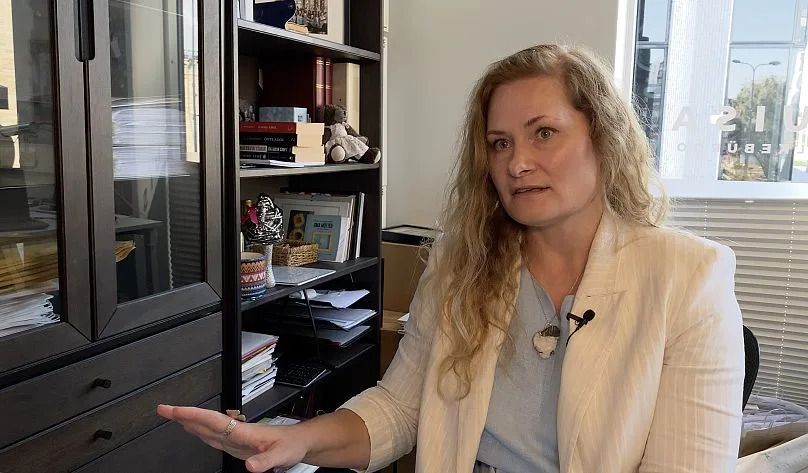
But this accelerating AI-driven innovation is already a challenging reality for many. One of Estonia's biggest translation agencies employs some 40 people between staff and freelances. Workers there don't necessarily fear for their jobs. But they apprehend how AI is already reshaping their working conditions. “Now the machine is translating so much faster. So translators are expected to handle more text, faster. But as the machine does half of the work or even more, then they get paid less for that. They have to do more work and get paid less. So this is also very frustrating.", explained Marge Žordania, the company's Head of Medical Translations.
Marge Žordania, Head of medical ranslations at Luisa Translation Agency - Euronews
Two out of three respondents to a recent survey said they fear that fewer workers will be needed as AI takes hold in Europe. But it still remains unclear to what extent this new technology will influence the day-to-day working lives of companies and employees across the continent.
Click on the video above to watch Julian's report in full
تم ادراج الخبر والعهده على المصدر، الرجاء الكتابة الينا لاي توضبح - برجاء اخبارنا بريديا عن خروقات لحقوق النشر للغير


