


اخبار العرب-كندا 24: الأربعاء 31 ديسمبر 2025 04:20 مساءً
Tuesday night’s water main rupture in Bowness was a second “catastrophic failure” of the Bearspaw south feeder main, city officials have confirmed.
At a Wednesday morning news conference, Mayor Jeromy Farkas and officials from the city and the Calgary Emergency Management Agency said acoustic monitoring did not indicate a second failure of the critical water artery was imminent.
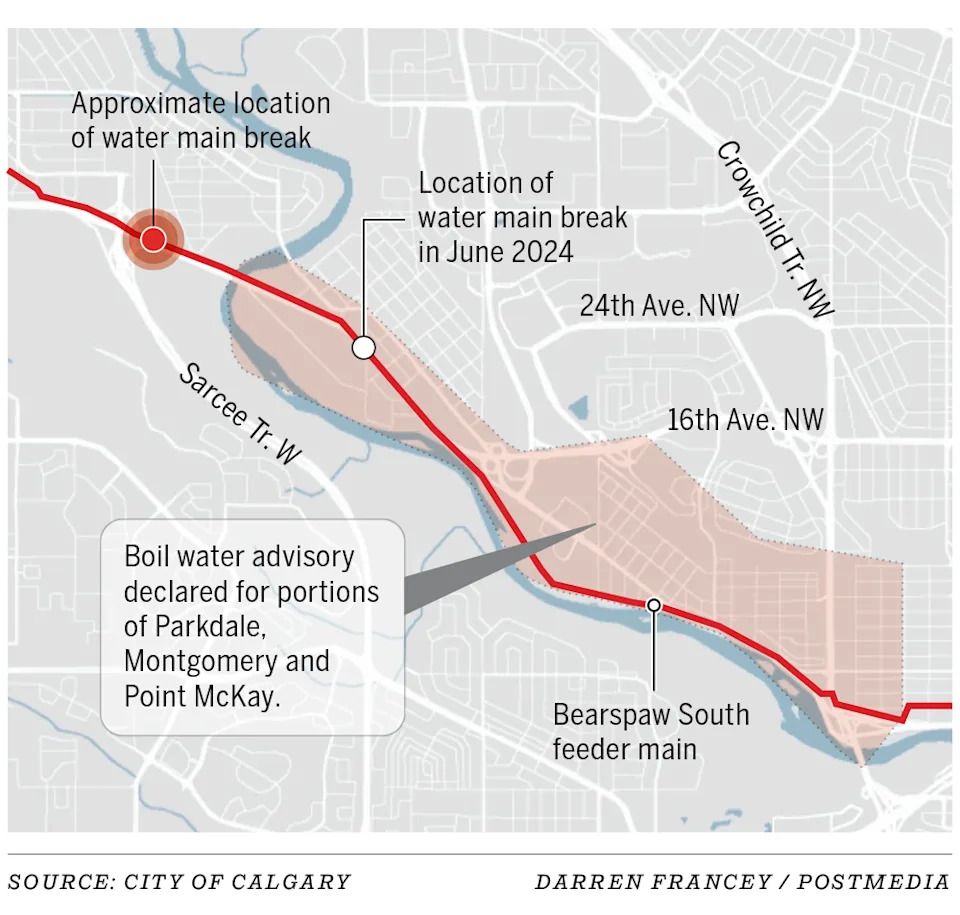
The break occurred below 16th Avenue N.W. around 7:45 p.m., just east of the Sarcee Trail interchange. Both roads are now closed in each direction and motorists are asked to avoid the area and follow detour signs.
Advertisement
Advertisement
Advertisement
Advertisement
The pipe’s rupture led to gushing water and flash flooding on 16th Ave., leaving 13 motorists in eight vehicles stranded until emergency responders could rescue them. No injuries were reported.
By early this morning, the city’s water team had shut off water flow to the affected area and identified the location of the break, said emergency management chief Sue Henry.
Given the size of the break and its impacts across Calgary, she said the municipal emergency plan was enacted and opened Calgary’s emergency operations centre.
“I want to take a moment to recognize that this event, given our recent history, may cause stress for a lot of Calgarians,” Henry said. “While we do not have all the answers today, our teams are working around the clock to protect Calgarians, protect our water system, keep it safe and flowing and to restore services as quickly as we can.”
Advertisement
Advertisement
Advertisement
Advertisement
The pipe that burst is one of Calgary’s most critical water lines, responsible for transporting 60 per cent of treated water from the Bearspaw treatment plant to underground reservoirs across the city.
It’s the same feeder main that burst in June 2024, causing a summer-long water crisis that included citywide outdoor watering restrictions and urges from city officials to curb indoor usage to avoid straining Calgary’s water supply.
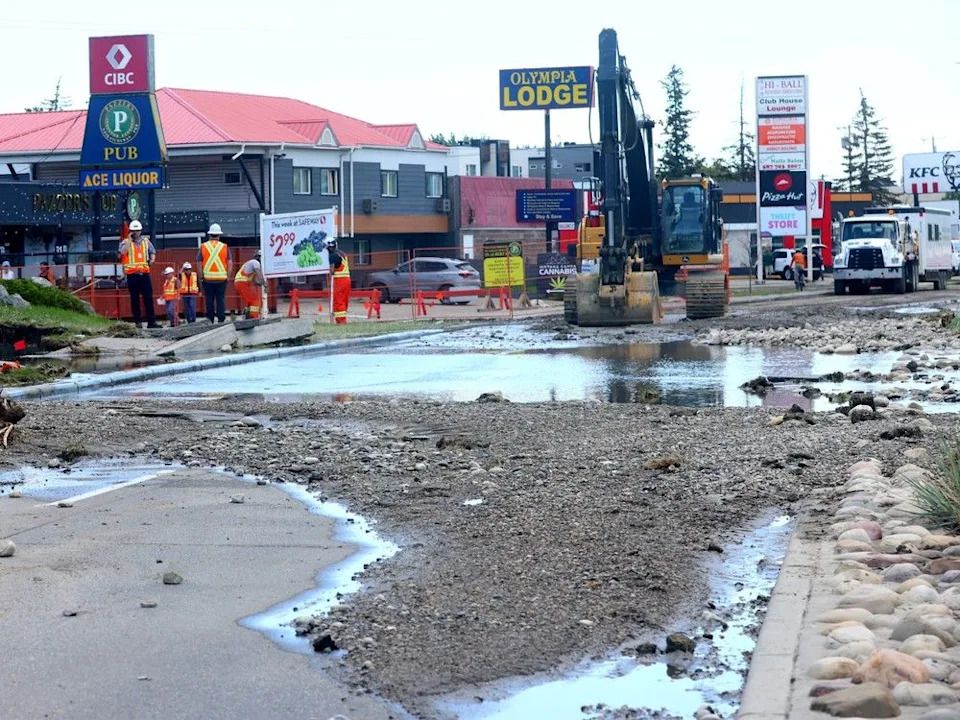
Workers at the site of a major water main break in Montgomery on Thursday, June 6, 2024.
Boil water advisories for three neighbourhoods, water restrictions for all other water users
This time around, a boil water advisory has been issued for Montgomery, Point McKay and Parkdale, the three neighbourhoods immediately downstream of the break. Water wagons will be distributed throughout these three communities for residents to access treated water, according to Henry.
Bearspaw south feeder main break
Stage 4 outdoor water restrictions are now in effect and Calgarians are being asked to reduce indoor use, such as by taking shorter showers, reducing toilet flushes and only running dishwashers or washing machines with full loads, to help conserve water.
Advertisement
Advertisement
Advertisement
Advertisement
Outdoor restrictions also apply to other communities that get their water from Calgary, including Airdrie, Strathmore and the Tsuut’ina Nation.
Until further notice, flooding of outdoor rinks, snow making or other large outdoor water usages are prohibited.
“Based on our learnings from last time, we’ve had to make emergency adjustments and we were able to move water differently within our network, to flow water from our smaller Glenmore water treatment plant throughout the city,” said the city’s water services director, Nancy Mackay.
“This means that we’re relying on less water to meet the demands of the entire city and surrounding region and communities that rely on City of Calgary drinking water.”
Replacement needed for ticking time bomb feeder main: Farkas
Calgary Mayor Jeromy Farkas speaks at a press conference after another water main break at 16th Ave & Home Road NW on Wednesday, December 31, 2025.
At Wednesday’s news conference, Mayor Jeromy Farkas called the feeder main a “ticking time bomb” that ultimately needs to be replaced, rather than just repaired.
Advertisement
Advertisement
Advertisement
Advertisement
“The status quo isn’t acceptable,” he said.
“This is a much more complex fix than going in and providing a few patches . . . Ultimately, it’s going to be requiring a brand new line to be able to reduce the reliance on this specific section.
“But rest assured, we took immediate steps to ensure that Calgarians were safe through the immediate emergency, we’ve stabilized the immediate emergency, and we’re pushing hard on the government accountability piece to ensure that our council is united and that this doesn’t happen again.”
The city does intend to twin a large section of the Bearspaw south feeder main as part of long-term plans to protect Calgary’s water distribution network and improve the system’s redundancy. Some of the construction work for that project is currently out for tender.
Advertisement
Advertisement
Advertisement
Advertisement
“It’s moving forward as fast as possible and the team working on it and will look for every opportunity to improve the schedule,” said Chris Graham, the city’s leader of utility asset management. “This break doesn’t necessarily impact the delivery of the project. It provides incentive to keep moving it forward at as fast a pace as possible.”
The bulk of the Bearspaw south feeder main, which is composed of pre-stressed concrete cylindrical pipe, was built in 1975. Twenty-nine sections of the 11.6-kilometre-long transmission line that were deemed at risk of failure were replaced following the original break in 2024. According to city officials, the part that burst Tuesday was not one of the repaired sections.
Furthermore, the feeder main’s acoustic monitoring system did not detect any wire snaps or other problems in the pipe before a major drop in water pressure was noticed, according to Graham.
“There’s nothing in the monitoring or in the operation of the pipe flows, the pressures, that would have indicated an issue before the pressure dropped,” he said.
Advertisement
Advertisement
Advertisement
Advertisement
“The pipe was being monitored continuously with acoustic fiber optic equipment and the system was working normally at the time of the failure.”
Water services director expects at least week-long water restrictions
The city expects repairs this time to be faster than following the 2024 break, due to learnings from the previous experience.
While she said she’s unsure how long outdoor water use restrictions will be in effect, Mackay predicted a repair timeline of seven to 10 days.
“We’ve identified where the break is much quicker,” she said. “We have emergency response plans, we have parts (in storage) and we are ready to roll, so we will lift restrictions as soon as we can.”
Advertisement
Advertisement
Advertisement
Advertisement
However, just like last time, the pipe still needs to be flushed and tested once it’s repaired, she noted.
“I understand people want to have more details on that, but we have to locate, dig, drain, replace, fill it up, test it for drinking water quality, backfill, and then move the water through the system,” she said.
“We go fast, but we don’t go so fast that we’re not protecting water quality, which is absolutely essential for Calgarians.”
تم ادراج الخبر والعهده على المصدر، الرجاء الكتابة الينا لاي توضبح - برجاء اخبارنا بريديا عن خروقات لحقوق النشر للغير


