



اخبار العرب-كندا 24: الأربعاء 31 ديسمبر 2025 08:08 صباحاً
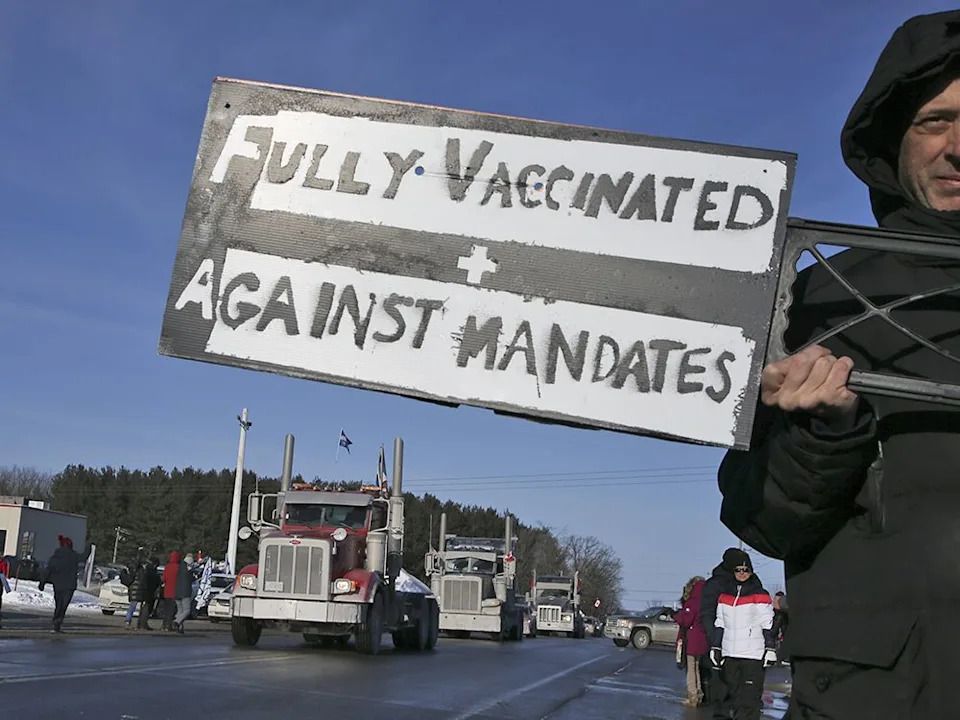
They were contentious, unprecedented and among the policies that drove long-haul truckers from across Canada to overtake Ottawa’s downtown core for nearly a month.
Now a new paper explores under what conditions vaccine certificates should, or shouldn’t ever, be considered again.
“If you look at some of the language used even during the convoy, it was ethics language. It was informed consent; it was around freedom and liberty and coercion,” said co-author Maxwell Smith, director of Western University’s Centre for Bioethics.
Advertisement
Advertisement
Advertisement
Advertisement
“These are profoundly ethical ideas. We need to confront that these are the sorts of concerns that people have and motivate things like the convoy. We need to get ahead of them to actually ask: were these measures coercive? Do they infringe on freedom in a way that we think is unethical or unjust?”
COVID began cutting its swath across the globe six years ago, when, on Dec. 31, 2019, reports of a strange “viral pneumonia” of unknown cause were first reported to the World Health Organization’s China Country Office, marking the beginning of a global pandemic that has contributed to the deaths of seven million people worldwide, according to WHO.
In Canada, vaccine certificates — individualized QR codes available in paper or digital form granting the fully vaccinated entry to restaurants, bars, theatres and other “high risk” settings — were implemented in 2021 and gradually phased out throughout 2022.
Future pandemic planning needs to go beyond stockpiling medicines and personal protective gear and building more ICU beds, said Smith. It’s also crucial to grapple with the fraught ethical conflicts COVID raised and ask, “What would we do differently?”
Advertisement
Advertisement
Advertisement
Advertisement
In their recently published paper, Smith and his colleagues propose that as three factors increase — pathogenicity, meaning the ability of the virus to harm the person infected, the prevalence of the virus itself and the protective effects of any vaccine — so, too, do the justifications for considering vaccine certificates.
Lower levels, they said, diminish the justification. In addition, “we then need to determine when we, collectively, think a pathogen is ‘sufficiently’ severe, prevalent, etc to. justify the use of vaccine certificates,” Smith said.
Higher scores for all three “will provide stronger justification for trade-offs with liberty,” Smith and his co-authors, the University of Ottawa’s Cecile Bensimon and Dr. Kumanan Wilson, wrote.
Their proposed framework could “quickly and clearly” sweep away arguments for using vaccine certificates, they said. “In other cases, it may offer compelling reasons” to seriously consider their use.
Advertisement
Advertisement
Advertisement
Advertisement
“If we don’t try to answer those questions and maybe try to socialize those answers with the Canadian public, we’ll be facing the exact same protests or confusion or contention with a future threat that we faced during COVID,” Smith said.
Vaccine certificates were deployed during the early waves to enable partial or full reopenings “whilst protecting the public’s health amidst an ongoing pandemic — two important goals for any pandemic response,” the paper says.
They were also widely criticized for violating individual liberty and autonomy, creating a “me-them” environment and even splitting families apart. Critics have called them “scientifically questionable,” polarizing and stigmatizing — part of far-reaching policies that imposed “the largest infringement on civil rights and liberties in living memory.”
They were originally based on several objectives: prevent transmission and make dining indoors and other gatherings safer, and reduce the burden of illness, disease and death. While the shots reduce the risk of severe outcomes, it became clear they weren’t providing “sterilizing” immunity, meaning complete protection. Vaccinated people could still get infected, and infect others. Immunity wanes over months.
Advertisement
Advertisement
Advertisement
Advertisement
An absence of sterilizing immunity — a vaccine that completely interrupts transmission of the virus — weakens the case for vaccine certificates, the paper says. “But it’s not the case that (COVID shots) did absolutely nothing in terms of the reduction of infection or transmission or severe illness,” Smith said.
“The all-or-nothing sometimes clouds our judgement.”
A customer has her COVID-19 QR code scanned by the manager of a fitness club in Montreal as the Quebec government’s COVID-19 vaccine passport comes into effect, Sept. 1, 2021.
How much impact vaccine certificates had during COVID is hard to disentangle, said University of Toronto medical microbiologist and infectious diseases specialist Dr. Allison McGeer.
“It is probably impossible to judge, in the setting of a pandemic, because there was so much going on at the same time. Teasing apart what was the effect of travel bans versus vaccine certificate requirements is really hard to do,” McGeer said.
Advertisement
Advertisement
Advertisement
Advertisement
“There’s a sense in moments of crisis you do what is the right thing now and pick up the pieces later,” she said.
One study estimated that 290,168 additional people in Canada received their first dose in the seven weeks after provinces announced proof-of-vaccination polices, “a 17.5 per cent increase over the number of vaccinations estimated in the absence of these policies.” But it was short lived: Uptake returned to “preannouncement levels,” or lower, within six weeks. The mandates remained in place for at least four months.
Quebec and Ontario were the first to introduce vaccine passports, in September 2021. By then, 82 per cent of those 12 and older in both provinces had already had one dose of a COVID vaccine. One study found that the number of first doses administered over 11 weeks increased by 23 per cent in Quebec, and 19 per cent in Ontario.
Overall, estimated coverage increased by 0.9 percentage points in Quebec, and 0.7 percentage points in Ontario, over the first 11 weeks, the authors wrote.
Advertisement
Advertisement
Advertisement
Advertisement
“By virtue of saying, ‘Going to restaurants, bars and theatres is conditioned upon you being vaccinated,’ that meant more people got vaccinated,” Smith said.
Whether that made those settings safer by virtue of everyone there being vaccinated “is a lot harder to measure,” he said. “We sometimes use a proxy: Did they have any broad population effects?”
At the time, hospitals were overwhelmed by a Delta-driven wave. “We didn’t have enough beds to go around,” Smith said. Doctors were considering rationing critical care. “The more vaccinations we had out there, the lower the risk of people being hospitalized. So, generally, you saw a lower severity of illness occurring,” Smith said.
Were vaccine certificates coercive? “That’s a tough question,” said Smith. “They did put pressure on people to get vaccinated. We wanted to live our lives. It didn’t force us to do it, but it did put pressure on us to do so.”
Supporters line a highway in Rigaud, Que., waving flags and signs at Freedom Convoy truckers headed to Ottawa to protest COVID vaccine mandates, Jan. 28, 2022.
He and his co-authors didn’t apply their framework to COVID. They don’t answer whether the COVID vaccine certificates, and the trade-offs with individual liberty, were justified. But they said it isn’t enough to satisfy the three conditions set out in their paper alone. Other considerations include whether the use of vaccine certificates “represents a tolerable approach to balancing public health aims with individual liberty and autonomy.”
Advertisement
Advertisement
Advertisement
Advertisement
“Questions such as this cannot be answered by science alone,” the paper reads. “Determining the point at which benefits are sufficient to justify proof-of-vaccination requirements requires making value judgments about what outcomes matter most (and for whom), what measures are necessary (and for whom) and whether those measures are proportionate or legitimate.”
“The value judgments of my co-authors and I are less important here than what the Canadian public values, since these are big policy decisions,” Smith said.
In addition to requiring proof of vaccination for many indoor spaces, vaccines were mandated for hospital staff, 268,000 federal public servants in “core public administration,” including members of the RCMP, college and university students returning to campuses and cross-border truckers.
Smith thinks the framework could be applied to mandates as well. “But I think there is some nuance that would change the moral calculus in important ways.”
Advertisement
Advertisement
Advertisement
Advertisement
People working in hospitals and health care have stronger ethical obligations to take steps to protect patients, he said. “Prevalence doesn’t necessarily need to be high to justify requirements in those settings.
“And because even so-called ‘mild’ diseases can severely harm or kill more vulnerable people, pathogenicity needn’t be high either,” he said.
Courts in Canada have generally found that governments had the authority to introduce vaccination requirements, he said.
“I think infringing on liberty is one thing. But I think the more important question is whether it was an unjust infringement on liberty,” Smith said.
Advertisement
Advertisement
Advertisement
Advertisement
“If we care about the most vulnerable people in society, we need to think about what sort of reductions of my own freedom might be necessary in order to protect other people’s freedom.”
The country was in a state of lockdown, Smith said. “Everything was closed, and it seemed the safest way forward, given the prevalence of the virus.
“We were looking for a way out.”
National Post
Our website is the place for the latest breaking news, exclusive scoops, longreads and provocative commentary. Please bookmark nationalpost.com and sign up for our daily newsletter, Posted, here.
تم ادراج الخبر والعهده على المصدر، الرجاء الكتابة الينا لاي توضبح - برجاء اخبارنا بريديا عن خروقات لحقوق النشر للغير


