


اخبار العرب-كندا 24: الثلاثاء 30 ديسمبر 2025 06:20 صباحاً
Next year, Ottawa police will get their biggest budget boost in more than a decade, but Chief Eric Stubbs could soon come looking for more.
In a year-end interview with CBC News, Stubbs laid out the pressures facing the Ottawa Police Service as he prepares for a long-term costing exercise that will help pin down the price of policing for years to come.
"We have to keep up," he said. "We have to invest in the police force to ensure that we can match the demands of this growing city, and that just hasn't happened for a number of years."
Advertisement
Advertisement
Advertisement
Advertisement
Violent crime is increasing. Case files are piling up in some units, with no resources to go after suspects. Stubbs is detecting a sense of insecurity in parts of the city.
"That perception that people have is real," he said. "In some neighborhoods they don't feel safe, and that's concerning to us. We hear that and we want to respond to that."
Stubbs said overall, Ottawa remains a safe city. The crime severity index, which takes the crime rate and gives more weight to serious offences, is among the lowest of any city in the country.
But some statistics are going in the wrong direction. According to November data, violent crime in Ottawa is up more than three per cent this year compared to the year before, when it rose slightly compared to 2023.
Advertisement
Advertisement
Advertisement
Advertisement
"It's a safe city, but we certainly have our issues," the chief said. "There's organized crime here. We have shootings. We have homicides. We have theft. We have robberies."
Case backlogs and a logjam in the courts
Stubbs said his officers have had success going after "prolific offenders" who commit those major crimes.
But many cases don’t result in charges, especially for less serious crimes. The clearance rate for the Ottawa Police Service is just 27 per cent, much lower than it was 10 years ago and behind most other large police services in Canada.
Stubbs blamed scarce resources and increasingly complex investigations. He also pointed a finger at the courts.
Advertisement
Advertisement
Advertisement
Advertisement
"Our courts are jammed," he said. "We have filled the court with criminal charges."
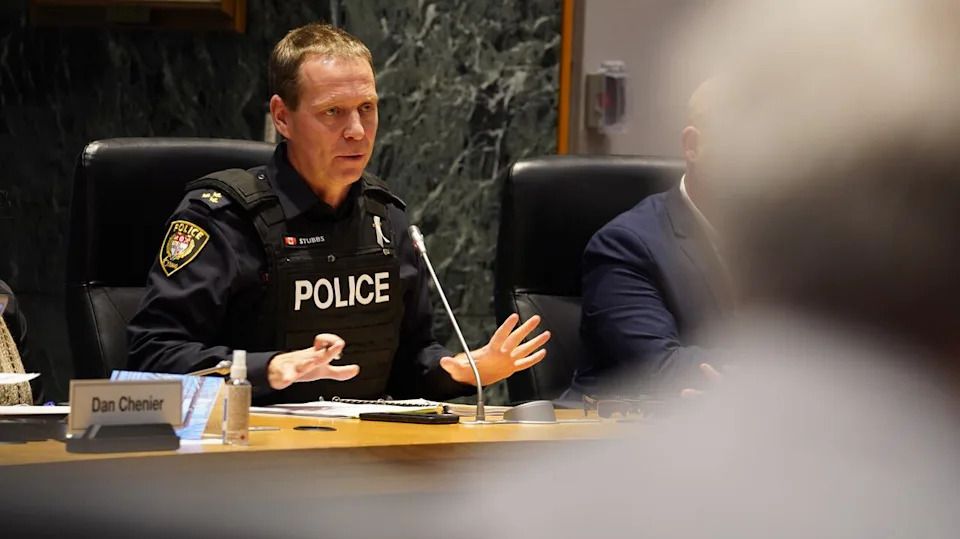
Default Caption: Chief Eric Stubbs speaks to city councillors during deliberations over the Ottawa Police Service's 2024 budget on Dec. 6, 2023. (Francis Ferland/CBC)
Earlier this month, Stubbs told city council some units are so understaffed that cases sit on the shelves. The fraud unit, with a staff of just 10, is dealing with some 6,500 reports this year, forcing them to triage each case. For cases that make the cut, it can take four or five months just to start an investigation.
Likewise, the integrated child exploitation unit can only tackle the most pressing cases. Stubbs said the unit lacks the resources to move on 1,800 tips about IP addresses in the Ottawa area that have been linked to downloads of child pornography.
"I could triple that team, and that tripled team would have more than enough work to do," Stubbs told CBC News.
Advertisement
Advertisement
Advertisement
Advertisement
The 2026 budget, with its 8.7 per cent boost for police, will fund 21 new sworn officer positions. But Stubbs was asking for more than 10 per cent, and a big chunk of the money will get eaten up by wage inflation.
"Policing is expensive," he noted.
He said Ottawa has to meet requirements under provincial law that ensure effective policing, but he knows he will be competing with other priorities in a tight budgetary environment.
"I understand it’s not an endless pot that is put aside for policing," he said.
Schools 'want us there'
Despite those constraints, Stubbs has a long list of plans for his officers. He said the OPS will be deploying still more officers to the ByWard Market next year. He said a hot spot policing model there has shown results, driving down crime in six problem areas that police targeted.
Advertisement
Advertisement
Advertisement
Advertisement
He’s also hoping to resurrect a school resource officer program, four years after the Ottawa-Carleton District School Board (OCDSB) voted to get police out of its schools.
Stubbs believes that was the wrong decision. Now, a new provincial law forces schools to grant police access and allow them to restore the programs.
He said it will look different this time around. For one thing, he doesn’t have as many officers available for the task. He’s also expecting a different welcome, and said he’s not planning to force his officers on the schools.
Stubbs said he’s already gotten positive signs from the OCDSB, which is now under provincial supervision.
Advertisement
Advertisement
Advertisement
Advertisement
"We're not imposing ourselves, getting our elbows up and coming into the schools uninvited," he said. "The schools that we’re in, they want us there."
He said the officers will be focused on building trust. They’ll work on prevention and education, rather than responding to calls.
"It is very important to us that we have relationships with the youth so we understand what's going on and then can avoid and hopefully prevent a lot of crime from occurring," Stubbs said.
Progress slow on Abdi recommendations
One year ago, an inquest into the death of Abdirahman Abdi directed 25 recommendations to the OPS. Abdi, a Somali-Canadian who was in the midst of a mental health crisis, died during a violent arrest in 2016.
Advertisement
Advertisement
Advertisement
Advertisement
In the wake of the inquest findings, Stubbs committed to repairing what he called a "fractured" relationship with the city’s Somali community.
"We certainly look forward to going in a positive path to build that trust and really actively help the Somalian community feel safe," he said.
But one year later, Stubbs acknowledged he hasn’t directly spoken with Somali community leaders since the inquest in that context.
"Not directly in terms of that relationship piece," he said.
He said he isn’t the only one involved, since the OPS also has a community safety well-being team and a diversity and race relations team.
Advertisement
Advertisement
Advertisement
Advertisement
"We're making progress, positive progress, but it's slow," he said. "The bottom line is, regardless of what happens, we will be better at responding to mental health calls for service."
AI-powered policing
Stubbs said the OPS has built a team to address the recommendations. In November, the service launched a pilot program to equip officers with 30 body-worn cameras, as recommended by the inquest.
Stubbs said the impact is limited, since police would need about 850 cameras to equip all of their officers. But he said the cameras have made a difference when it comes to collecting evidence.
Advertisement
Advertisement
Advertisement
Advertisement
“We had one call where somebody had a sword and our members were able to capture all of that behavior," he said.
According to Stubbs, the footage has even documented concerning behaviour during mental health calls that's persuaded psychiatrists to commit people who needed help.
He’s hoping to continue rolling out the cameras next year, but he noted they aren’t cheap, and getting one for every officer on duty would require a new investment from the police service board.
The cameras do more than capture what goes on during a call: Stubbs said they help write reports and even offer AI translation services.
Advertisement
Advertisement
Advertisement
Advertisement
He said that’s only one area where the service is looking to the future and applying AI-based technologies to policing. They’re also working on an AI-assisted response system for non-911 calls.
"We’ve got a lot of irons in the fire," Stubbs said.
تم ادراج الخبر والعهده على المصدر، الرجاء الكتابة الينا لاي توضبح - برجاء اخبارنا بريديا عن خروقات لحقوق النشر للغير


