


اخبار العرب-كندا 24: الاثنين 29 ديسمبر 2025 04:32 صباحاً
OTTAWA — If emotions over U.S. President Donald Trump’s tariffs and his comments about coveting Canada as a “51st state” defined the posture of political leaders towards the cross-border relationship in 2025, business leaders are urging that cool heads prevail in the new year.
With Canada set to begin formal talks with the U.S. over its trilateral agreement with Mexico in January, National Post asked different leaders in business and labour about their hopes for how Prime Minister Mark Carney’s government approaches the deal’s joint review and what lessons elected officials could learn from the past year.
What emerged was a message of pragmatism.
Advertisement
Advertisement
Advertisement
Advertisement
“We’ve had the year of elbows up,” said Goldy Hyder, president and CEO of the Business Council of Canada.
“When you do that in a hockey game, you end up in the penalty box. It’s far more important in 2026 that we, you know, win face-offs, put shots on the net, and put pucks in the net. That’s what’s going to be more important.”
Following a year where national pride surged in the face of Trump’s tariffs, Canadians have heard a lifetime’s worth of hockey analogies from political leaders as they describe their approach to the U.S.
That includes from Carney himself.
The avowed hockey fan prime minister turned to the national sport back in August when explaining why he was dropping a suite of retaliatory tariffs on U.S. goods covered by the trade agreement, despite winning the spring election campaign on an “elbows up” message, which meant hitting back hard against the U.S in the face of tariffs.
Advertisement
Advertisement
Advertisement
Advertisement
Carney suggested that the time for throwing elbows was over in favour of maneuvering the metaphorical puck into the metaphorical net to score the not-so-metaphorical goal of landing a deal with Trump that would see tariffs on steel and aluminum lowered, if not altogether removed.
Six months later, he has yet to put a win on the board, suggesting Canadians instead cheer for the fact that a majority of goods enjoy exemptions under the Canada-U.S.-Mexico Agreement, putting Canada in one of the best positions compared to other U.S. trading partners.
Dealing with those tariffs will now form part of the government’s efforts when it comes to working with the U.S. on the first review of the trade agreement, negotiated during Trump’s first term in office.
Unifor national president Lana Payne said the fact that Canada is still dealing with sectoral tariffs means it was starting those talks “slightly on our back heels.”
Advertisement
Advertisement
Advertisement
Advertisement
At the same time, with U.S. inflation and unemployment rising as the American economy deals with the impact of the president’s tariffs, Payne says Canada can use that to its “advantage” in bargaining with the U.S.
“All of these things are helpful to us.”
While Carney may also feel that time is on his side, Hyder said the opposite is true for business.
“What we have said to them is, one of the things you need to remember is, it may be your friend politically, but it’s not our friend from a business perspective.”
One risk, according to Hyder, is that 2026 ends without a joint review having been completed, which only fuels uncertainty the longer its extension sits unresolved.
Advertisement
Advertisement
Advertisement
Advertisement
The business council president said leaders should also not count on what lessons were learned from negotiating with Trump on the current agreement and apply it this time around, given how much more aggressive his administration is on enacting his trade agenda.
Matthew Holmes, executive vice-president and chief of public policy at the Canadian Chamber of Commerce, cautioned against thinking that suggests Canada should look to milestones like the 2026 U.S. midterm elections, scheduled for next November, when it comes to its strategic approach to the trade talks.
“We shouldn’t be ragging the puck, so to speak,” he said.
Given the U.S. signalling it plans to focus on issues like Canada’s supply-managed dairy sector as part of the joint review, as well as digital policies like the Online Streaming Act, Payne said it will be important for Canada to be “very clear about our own red lines.”
Advertisement
Advertisement
Advertisement
Advertisement
In her mind, Trump’s negotiating strategy over the past year can be summed up as, “the more you give, the more he wants.”
As for the question of whether it was time to move on from the “elbows up” attitude in 2026, Holmes at the chamber said it was complicated, as Carney finds himself in a difficult spot, given how the prime minister must reflect what Canadians feel.
Canada was one of only two countries that retaliated against Trump’s tariffs, the other being China. Data also shows that Canadians remain strongly opposed to the U.S., given how many opted against vacationing south of the border.
The message that business is giving to the government, the Canadian government, is be practical, be pragmatic
Advertisement
Advertisement
Advertisement
Advertisement
Holmes says it has nevertheless been important to see Canada adjust its position.
“That’s what personally I want to see from elected government,” he said. “I don’t want to see, you know, a calcified version of an election campaign for four years.”
“We’re seeing a government that is careful, that is listening both to its domestic population but also to the situation around it, that it needs to be able to be somewhat nuanced and fluid.”
In terms of advice for the new year, Holmes said it remains crucial to take the president at his word versus argue “facts or logic with what are kind of the … visceral vibes of the American electorate.”
Advertisement
Advertisement
Advertisement
Advertisement
“Don’t brush them off.”
Making the case for the Canada-U.S. trade relationship directly to leaders’ American counterparts is a must, according to Laura Dawson, director of the Future Borders Coalition, which advocates for the cross-border relationship and includes members like major Canadian airlines and airports.
She said Canadian leaders ought to do so by coming armed with specifics and precise data points.
“The Americans have consistently, historically, been surprised by how well prepared Canadians have been on technical issues,” said Dawson.
She said Canada’s trade negotiators are very skilled, but that the “missing piece” remains “continuous communication and consultation with Canadian businesses who are involved in integrated supply chains.”
Advertisement
Advertisement
Advertisement
Advertisement
Dawson said they are hearing from members looking for more “technical engagement” from the government.
At the political level, she says, business sent a message to Ottawa this year that, as it sought to diversify its market access in response to Trump’s tariffs, while some were in a position to shift away from the U.S., many businesses were not, given the depth of integration between Canada-U.S. supply chains.
“The message that business is giving to the government, the Canadian government, is be practical, be pragmatic.”
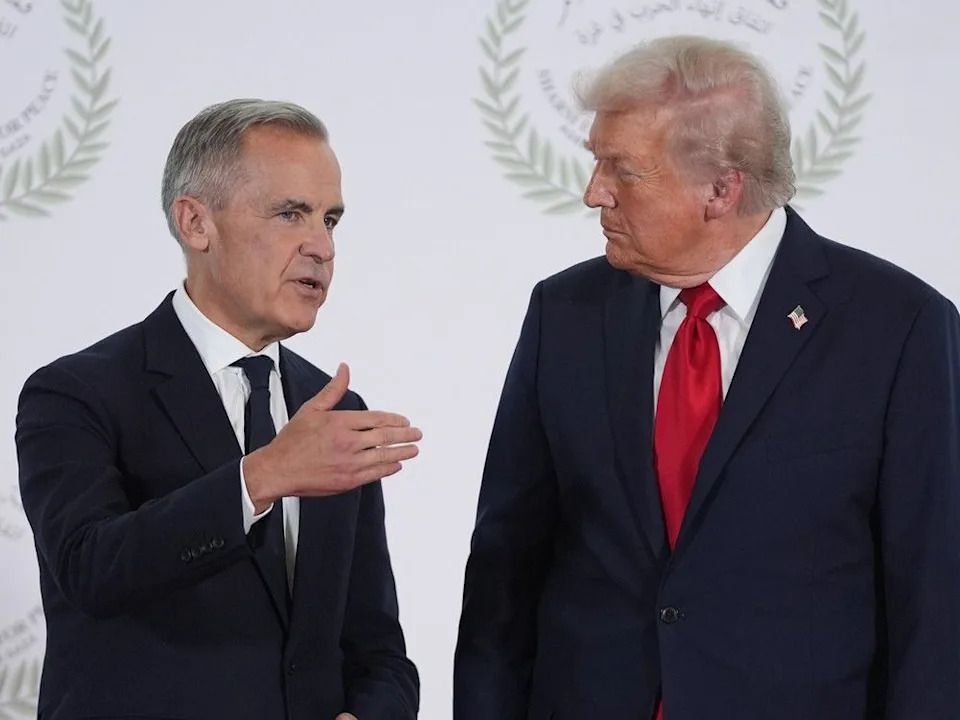
Prime Minister Mark Carney speaks with U.S. President Donald Trump in Sharm El Sheikh, Egypt, on Oct. 13, 2025.
Dawson also said trade policy is “much more politicized” at the White House, which has a very specific agenda when it comes to remaking global trade. She believes the message from the Trump administration to Canada is, “‘You’re either on board or you’re not, but we are going to go ahead.'”
Advertisement
Advertisement
Advertisement
Advertisement
Payne said the federal government must also bring sectors together to ensure that Canada enters trade talks with a unified front.
As the trade war dragged on, Carney faced more fractured calls from premiers looking for support and action against the U.S. in advocating for their different industries, from softwood lumber, autos, and canola products, the latter dealing with tariffs from China.
“We need a very, very strong Team Canada approach in 2026.”
National Post
Our website is the place for the latest breaking news, exclusive scoops, longreads and provocative commentary. Please bookmark nationalpost.com and sign up for our daily newsletter, Posted, here.
تم ادراج الخبر والعهده على المصدر، الرجاء الكتابة الينا لاي توضبح - برجاء اخبارنا بريديا عن خروقات لحقوق النشر للغير


