


اخبار العرب-كندا 24: السبت 27 ديسمبر 2025 04:44 مساءً
As of the day after Boxing Day, 32 people had been killed in collisions on Edmonton roads in 2025. More than 100 suffered serious injuries. Tickets for speeding are up, as are charges for impaired driving.
For Edmonton’s new police chief, the carnage on the roads has been a major challenge during his first months on the job — a problem he attributes in part to the province’s clampdown on photo radar.
“We’ve seen a change in driver behaviour,” Chief Warren Driechel said in a year-end interview with Postmedia. “I travel a constant route in the city where there used to be a succession of speed-on-green cameras; where people were speeding 10 kilometres over the speed limit, they’re doing 20 now.”
Advertisement
Advertisement
Advertisement
Advertisement
Police are trying to fill the gap with more in-person traffic enforcement, writing nearly 20 per cent more tickets than last year, but the effect has been limited.
“We’re seeing more egregious speeds on the Henday and the Whitemud (freeways), we’re seeing an increase in the number of tickets that we’re writing for excessive speed, we’re seeing more tickets and charges for things like dangerous driving.”
The numbers
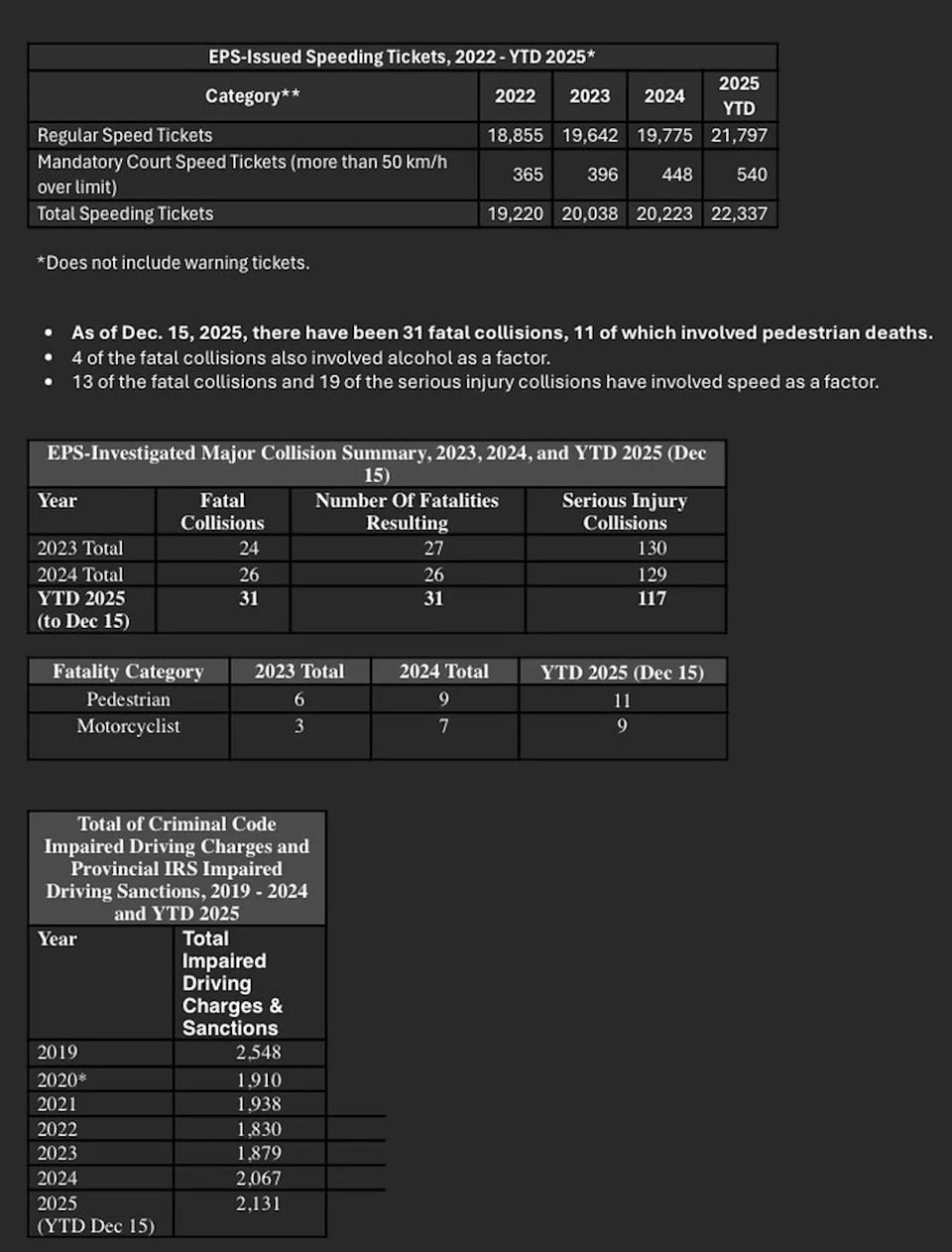
This year’s 32 roadway fatalities surpassed the 26 deaths in 2024, the 24 deaths in 2023 and the 10-year average of 23.8. It tied the 10-year high set in 2015 and far exceeded the low of 12 in the first year of the COVID-19 pandemic.
Of this year’s 32 deaths, 11 were pedestrians and nine were motorcyclists. Thirteen of the fatal collisions and 19 of those causing serious injuries involved excessive speeds. Alcohol played a role in four of the deadly crashes.
Advertisement
Advertisement
Advertisement
Advertisement
As for collisions causing serious injuries, there were 117 as of Dec. 15, slightly below the year-end totals for each of the last two years, with 129 in 2024 and 130 in 2023.
Calgary (which, like Edmonton has seen a surge in population) has also seen a particularly deadly year on the roads.
In response to the photo radar phaseout, Edmonton Police Service (EPS) ramped up traditional enforcement. As of mid-December, officers had issued 22,337 speeding tickets, compared to 20,223 in 2024.
And 540 of the 2025 tickets included a mandatory court summons for exceeding the speed limit by 50 km/h — nearly 100 more than the previous year.
Edmonton police traffic collision statistics. Supplied Photo
Provincial Transportation Minister Devin Dreeshen announced sweeping cuts to photo radar in 2024, amounting to a 70 per cent reduction in cameras. While Dreeshen’s changes allowed photo radar enforcement to continue in school, playground and construction zones, the City of Edmonton ended photo radar near schools this summer, saying the cost of the program was funded by revenue from photo radar on roads where it is now banned.
Advertisement
Advertisement
Advertisement
Advertisement
City councillors in Edmonton began calling for the program to be reinstated as early as this summer as traffic deaths mounted.
In a statement, a transportation ministry spokesperson touted a $13-million traffic safety fund for municipalities to improve high-risk collision locations “through measures like better signage, signal timing, traffic calming, lighting, and road redesign — investments that prevent collisions before they happen.
“We continue to support police-led enforcement efforts and data driven safety solutions, while ensuring traffic safety tools are focused on reducing dangerous behaviour. Improving safety requires coordination at every level of government, and Alberta remains committed to working with municipal and policing partners to help keep all road users safe.”
Different approaches
Earlier this month, Dr. Louis Francescutti, an Edmonton emergency room physician recently appointed chairman of the board of the Canadian Centre on Substance Use and Addiction (CCSA), said standalone traffic safety units like one proposed in November by Mayor Andrew Knack could be the wrong approach.
Advertisement
Advertisement
Advertisement
Advertisement
The mayor made the suggestion after a 58-year-old woman was fatally struck by an SUV while walking her dog at a marked crosswalk in north Edmonton, prompting Knack to call for a dedicated traffic safety unit mirroring what is done in Calgary.
But, said Francescutti, a traffic squad conducting periodic blitzes “cannot replace routine, visible enforcement by every officer on the road,” he said, calling for consistent enforcement, 24 hours a day, seven days a week, 365 days a year.
Driechel said the majority of traffic tickets issued in the city do come from traffic enforcement officers. However, there is currently a push for patrol officers to play a larger role.
“We want more enforcement, so we’re seeing our patrol officers do it when they can,” he said. “But when they’re starting their shift and there’s 80 calls for service, when do you wedge the traffic stop in unless it’s really egregious? So that’s what we’re saying: get after that really egregious behaviour.”
Advertisement
Advertisement
Advertisement
Advertisement
Driechel added that despite the increase in tickets, revenue from tickets is down, suggesting people aren’t paying their fines as often.
“I don’t know what’s happening on the other side. Are people being held accountable for tickets? We’re trying to look into that.”
Speed no factor in latest pedestrian deaths
Ryan Jacques, a board member with the Edmonton pedestrian safety group Paths for People, lays some of the blame for this year’s fatalities on the photo radar phaseout.
But in a report to city council earlier this month, the group noted speed does not appear to have been a factor in any of the 11 pedestrian fatalities. Six involved left turns and eight were “reasonably preventable” with improved infrastructure design, the report said.
Advertisement
Advertisement
Advertisement
Advertisement
Of the 12 fatalities publicly confirmed to have involved speeding, “11 were self-inflicted by the speeder, including eight speeding motorcyclists.”
“If we really want to solve the carnage on our streets, we need safer road design,” Jacques said. “We need to get to the fundamentals of this. If you design a road where people don’t feel safe to speed, or they don’t feel safe making a quick left turn without checking, then we will have much safer roads, and then we don’t need police officers cruising every block.”
jwakefield@postmedia.com
x.com/jonnywakefield
@jonnywakefield.bsky.social
Related
Bookmark our website and support our journalism: Don’t miss the news you need to know — add EdmontonJournal.com and EdmontonSun.com to your bookmarks and sign up for our newsletters.
You can also support our journalism by becoming a digital subscriber. Subscribers gain unlimited access to The Edmonton Journal, Edmonton Sun, National Post and 13 other Canadian news sites. The Edmonton Journal | The Edmonton Sun
تم ادراج الخبر والعهده على المصدر، الرجاء الكتابة الينا لاي توضبح - برجاء اخبارنا بريديا عن خروقات لحقوق النشر للغير


