



اخبار العرب-كندا 24: السبت 27 ديسمبر 2025 05:20 صباحاً
Advocates say the observer program for Atlantic Canada’s fisheries is ‘broken,’ with many fisheries failing to meet required levels for monitoring by at-sea observers.
The at-sea observer program has been plagued by labour shortages, particularly since the COVID-19 pandemic, meaning many fishing vessels are not carrying at-sea observers with them as frequently as required by Fisheries and Oceans Canada targets.
Many fisheries are falling well below coverage targets, according to advocates and documents obtained by CBC News through access to information requests.
Advertisement
Advertisement
Advertisement
Advertisement
Electronic tools exist to fill in the gaps, advocates say. In the meantime, without sufficient coverage, information needed to effectively manage stocks is lacking.
“We've just reached a point that the system is broken,” said John Couture, senior fisheries adviser with the non-government organization Oceans North. “When you're told at a meeting that no fisheries in this region are meeting the targets … well, we're basing decisions on data that we don't have.”
At-sea observers help with monitoring, compliance
The at-sea observer program exists to independently observe harvesters’ fishing activity at sea.
Advertisement
Advertisement
Advertisement
Advertisement
Observers are responsible for monitoring interactions with bycatch, taking measurements of targeted catch (like fish length and weight), securing biological samples and recording information. For some fisheries, that information is the primary source of scientific data.
This helps managers understand how much quota is remaining and what other species fisheries are interacting with, and maintains compliance, so that harvesters aren’t using the wrong nets or hooks, for instance.
Documents obtained by the CBC show that as of 2024, some fisheries — like winter flounder, silver hake and inshore halibut — had observers less than one per cent of the time, if they had any at all. Coverage targets are set at five to 20 per cent, and in some cases 100 per cent, depending on the fishery.
‘We just haven’t had enough human observers’
Observer coverage is now provided by private companies. DFO regulates companies and sets targets, and fishing associations and individual fishermen pay for observers. Having observers is a licence condition in many fisheries.
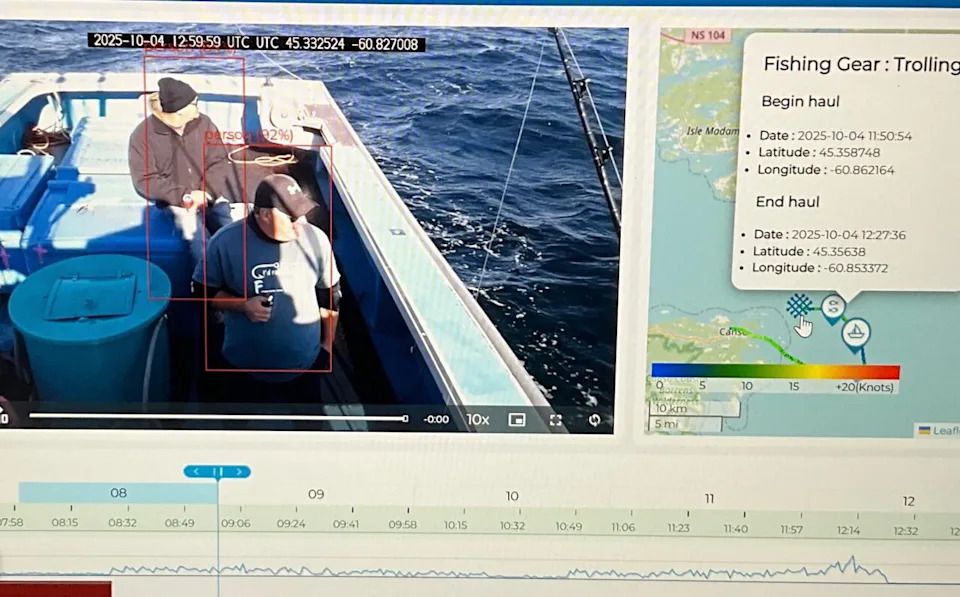
A screenshot from the electronic monitoring system Oceans North piloted this year, which uses cameras and AI to monitor fishing activity. (Submitted by John Couture)
Initially, the program was run internally by DFO, but it was offloaded to industry in the mid-2000s.
Advertisement
Advertisement
Advertisement
Advertisement
Katie Schleit, fisheries director with Oceans North, said even before the pandemic, some fisheries weren’t meeting their targets. But after the pandemic — which made at-sea observing especially difficult — the problems have only grown.
“We just haven't had enough human observers to fulfil the basic needs.”
Oceans North piloted an electronic monitoring system this year that uses cameras and artificial intelligence to monitor fishing activity.
Coverage issues stem from labour shortages
In documents obtained through access to information requests, DFO managers note that observer companies reported issues retaining staff, as well as a reluctance from observers to go on trips that originate in far-flung rural areas.
Katie Schleit is the fisheries director for Oceans North. (Robert Short/CBC)
Documents also note lack of bunk and life-raft capacity meant observers wouldn't or couldn’t go along. Advocates note the low pay for observers relative to the difficulty of the job is also an issue.
Advertisement
Advertisement
Advertisement
Advertisement
Without sufficient observers, Schleit said some fisheries are at risk of losing Marine Stewardship Council certification, a sustainability certification that mandates observers as part of their traceability requirements.
A 2025 memo obtained through an access to information request lays out conditions for ongoing council certification in the tuna and swordfish fisheries, some of which would require increasing observer coverage to 10 per cent by 2028 (from two per cent in 2024).
Gaps in observer coverage could harm fisheries’ marketability and sustainability, Schleit said. Still, she said there doesn’t seem to be a departmental-level effort to address the problem at DFO.
“I don't think they're understanding the urgency and the need for the overhaul of this program,” she said.
Advertisement
Advertisement
Advertisement
Advertisement
In a statement, DFO said the department is working “to modernize the at-sea observers program by updating the national policy, creating a national system (repository) to store and manage information about the program to better address issues, and establish a team to more clearly define responsibilities related to the catch monitoring programs.”
In the meantime, harvesters say putting increased responsibility for monitoring on fishermen could increase financial pressures.
MORE TOP STORIES
تم ادراج الخبر والعهده على المصدر، الرجاء الكتابة الينا لاي توضبح - برجاء اخبارنا بريديا عن خروقات لحقوق النشر للغير


