


اخبار العرب-كندا 24: الأحد 21 ديسمبر 2025 04:20 مساءً
The winter solstice has arrived, which marks the shortest day and longest night of the calendar year in the northern hemisphere. From here on out, daylight gradually increases as the Sun rises higher in the sky every day.
While this may seem like good news, the change will not be noticeable right away. Early in the season, daylight increases gradually, so darker mornings and evenings will continue to be a part of daily life for several weeks.
Later Sunday morning, the Earth approaches the point in its orbit where it tilts the farthest away from the Sun. That moment marks the official start of astronomical winter and the start of a gradual shift toward longer days.
DON'T MISS: The fascinating significance behind our winter solstice celebrations
Why daylight returns slowly at first
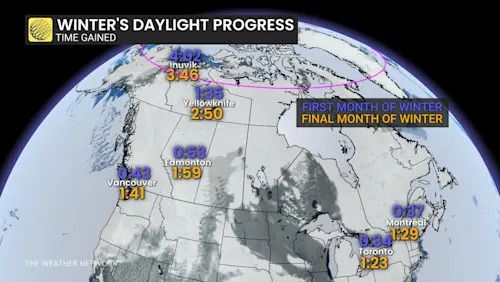
Although daylight begins to increase immediately after the solstice, the rebound is weakest during the first third of the winter. Across southern Canada, the shift is only a few minutes over several weeks.

Winter Solstice, Coldest Day, Temperature, December 21, 2025. (The Weather Network/Kevin MacKay)
Farther north, the difference is more obvious. Northern communities receive more daylight than southern Canadian cities, despite the fact that the Sun's angle increases at the same rate everywhere. Latitude has a big impact on how quickly daylight returns.
Advertisement
Advertisement
Advertisement
Advertisement
As the winter progresses, daylight increases. Many cities will have more than an hour more daylight by the end of the season than when they began.
MUST SEE: Here's how animals survive the coldest months
Coldest days still lie ahead
Despite longer days, temperatures across the majority of the country are still dropping following the solstice. The coldest average temperatures are typically recorded in January, long after daylight has begun to increase.
This delay takes place due to land and water needing time to respond to changes in sunlight. Snow cover, ice growth and lingering Arctic air all contribute to low temperatures through the middle of winter.
2025, Winter Solstice, Cold, Daylight, December 21, 2025. (The Weather Network/Kevin MacKay)
The exception is coastal areas, where the ocean controls temperature fluctuations. Elsewhere, winter's coldest stretch typically arrives weeks after the solstice, followed by a more apparent warm-up toward the end of the season.
Header image courtesy of Unsplash.
WATCH: Canada's active and cold winter persists into the new year
Click here to view the video
تم ادراج الخبر والعهده على المصدر، الرجاء الكتابة الينا لاي توضبح - برجاء اخبارنا بريديا عن خروقات لحقوق النشر للغير


